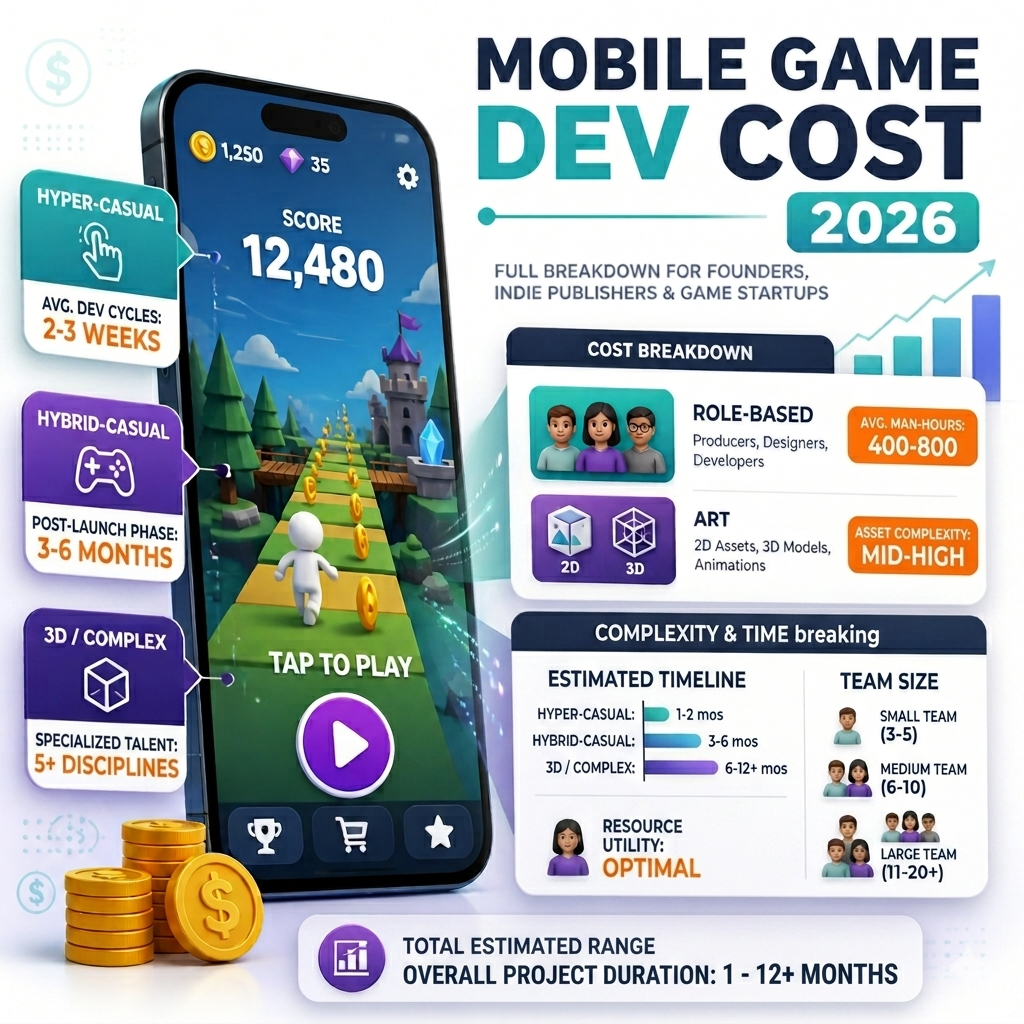
Mobile game development cost in 2026 depends on the game’s genre, features, art style, platforms, and the team you choose to work with. A simple mobile game can start from a small MVP budget, while a larger game with multiplayer, advanced progression, backend systems, and live operations can require a much higher investment.
For founders, indie publishers, gaming startups, and product managers, the most important thing is not only the total cost. The real goal is to understand where the money goes, how to control the budget, and how to build a high-quality mobile game without overspending.
This is where outsourcing to India becomes a strong advantage. India offers experienced Unity developers, 2D and 3D artists, game designers, QA testers, and full-cycle game development studios at much lower development rates compared to the US, Canada, and Europe.
In this guide, we will break down the main factors that affect mobile game development cost in 2026 and explain why India is one of the best choices for affordable, high-quality mobile game development.
What Actually Drives Mobile Game Development Cost in 2026?
The cost to develop a mobile game depends on multiple production factors. Even two games in the same genre can have very different budgets depending on scope and quality expectations.
The major cost drivers include:
| Cost Factor | How It Affects Budget |
| Game genre | Simple casual games cost less than strategy, RPG, or multiplayer games |
| Gameplay depth | More systems, upgrades, and progression increase cost |
| 2D or 3D art style | 3D games usually need more modeling, animation, lighting, and optimization |
| Number of levels | More levels mean more design, testing, and balancing |
| Characters and assets | Custom characters, props, VFX, and UI increase production time |
| Multiplayer/backend | Online features add server, database, matchmaking, and security work |
| Platform support | Android-only is cheaper than Android + iOS |
| Studio location | India offers much lower development rates with strong technical expertise |
| Engagement model | Fixed-price, dedicated team, and hourly models all affect pricing differently |
The best way to control mobile game development pricing is to start with a clear scope and build only the most important features first.
Mobile Game Development Cost by Game Type
Different game types require different levels of design, development, art, QA, and optimization. Below is a simple comparison of cost complexity by genre.
| Game Type | Cost Level | Development Complexity |
| Hyper-Casual Game | Low | Simple mechanic, short timeline, fast testing |
| Hybrid-Casual Game | Medium | Core loop + upgrades, rewards, and retention systems |
| Puzzle Game | Low to Medium | Level design, boosters, UI polish, and progression |
| Tower Defense Game | Medium to High | Units, waves, enemy AI, upgrades, and balancing |
| Mid-Core RPG / Strategy Game | High | Progression, backend, economy, live ops, and large content |
| Kids / Educational Game | Low to Medium | Simple gameplay, learning content, safe UI, compliance needs |
Instead of investing heavily from day one, most founders should begin with an MVP or vertical slice. This helps validate the idea before moving into full production.
Hyper-Casual Game Development
Hyper-casual games are usually the most budget-friendly mobile games to build. They focus on one simple mechanic, quick sessions, easy controls, and fast market testing.
These games are ideal for founders or publishers who want to test multiple ideas quickly before scaling the best-performing concept.
Common requirements include:
| Requirement | Purpose |
| Simple core mechanic | Easy to understand within seconds |
| Basic 2D or 3D visuals | Keeps production lean |
| Level generator or short level set | Helps create replayability |
| Ads integration | Supports monetization |
| Analytics | Helps track player behavior |
Hyper-casual games are a good starting point when the goal is fast development and low-risk market validation.
Hybrid-Casual Game Development
Hybrid-casual games are more advanced than hyper-casual games. They combine simple controls with deeper progression, upgrades, rewards, missions, and retention systems.
These games are popular because they can offer better long-term engagement while still keeping gameplay easy for casual players.
Common features include:
| Feature | Why It Matters |
| Upgrade system | Gives players long-term goals |
| Reward economy | Supports retention and monetization |
| Meta progression | Adds depth beyond the core loop |
| Daily rewards | Encourages repeat sessions |
| Ads and IAP setup | Improves revenue opportunities |
Hybrid-casual games are a strong choice for studios and publishers looking for a balance between simple gameplay and better monetization potential.
Puzzle Game Development
Puzzle games are one of the most popular categories in mobile gaming. They can be built with 2D or 3D visuals and usually focus on solving, sorting, matching, merging, or arranging objects.
Puzzle game cost mainly depends on the number of levels, art polish, difficulty balancing, boosters, and UI quality.
Common puzzle game systems include:
| System | Purpose |
| Level progression | Keeps players moving forward |
| Boosters | Adds monetization and strategy |
| Difficulty curve | Controls player challenge |
| Visual feedback | Makes the game satisfying |
| Event levels | Helps with long-term engagement |
Puzzle games are a good option for startups because they can be scaled step by step after the core mechanic is proven.
Tower Defense Game Development
Tower defense games require more planning than simple casual games because they involve enemy waves, unit behavior, upgrade systems, map design, and game balancing.
The cost increases when the game includes many towers, enemies, skills, maps, or PvP systems.
Important systems include:
| System | Purpose |
| Enemy wave logic | Controls level challenge |
| Tower/unit upgrades | Adds strategy |
| Map paths | Creates tactical gameplay |
| Enemy AI | Improves gameplay depth |
| Balancing tools | Helps tune difficulty |
A tower defense game can be built in stages, starting with a small number of units and maps before expanding into a larger content pipeline.
Mid-Core RPG and Strategy Game Development
Mid-core RPG and strategy games require the most planning and production effort. These games usually include character progression, economy systems, upgrades, inventory, missions, backend support, and long-term content updates.
They are better suited for companies that already have a clear product strategy, funding, and long-term live-ops plans.
Common systems include:
| System | Purpose |
| Character progression | Builds long-term engagement |
| Inventory and rewards | Supports player growth |
| Backend systems | Manages user data and online features |
| Economy balancing | Controls monetization |
| LiveOps | Adds events and updates after launch |
For startups, it is better to first build a smaller prototype before investing in a full RPG or strategy game.
Kids and Educational Game Development
Kids and educational games usually focus on simple gameplay, learning goals, safe UI, friendly visuals, and age-appropriate content.
These games may also require additional privacy and compliance checks, especially if they are designed for children.
Common requirements include:
| Requirement | Purpose |
| Simple controls | Easy for children to use |
| Friendly art style | Builds trust and appeal |
| Educational content | Supports learning outcomes |
| Voiceover and sounds | Improves engagement |
| Safe user experience | Important for children’s apps |
Kids and educational games can be developed affordably when the scope is clear and the content is planned properly.
Mobile Game Development Cost by Phase
A mobile game budget is usually divided across design, art, development, testing, publishing, and post-launch support.
| Development Phase | Budget Share |
| Game Design and GDD | 5–10% |
| 2D / 3D Game Art | 20–35% |
| Unity Development | 30–40% |
| QA Testing | 8–12% |
| Publishing Support | 5–8% |
| Post-Launch Updates | Based on monthly support needs |
This breakdown helps founders understand where the investment goes and why a clear production plan is important before development begins.
Game Design and GDD
Game design includes concept development, core mechanics, level flow, economy planning, monetization ideas, UI flow, and the Game Design Document.
A clear GDD reduces confusion during production and helps the team avoid unnecessary rework.
This phase is especially important for hybrid-casual, puzzle, tower defense, and strategy games.
2D and 3D Game Art
Art production includes characters, environments, props, UI, icons, animations, VFX, splash screens, and store graphics.
A simple 2D game costs less than a polished 3D mobile game, but visual quality still matters. In 2026, even casual players expect attractive visuals, clean UI, and satisfying animations.
The best way to reduce art cost is to finalize the art style early and reuse modular assets wherever possible.
Unity Game Development
Unity is one of the most preferred engines for mobile game development because it supports both Android and iOS and works well for 2D, 3D, puzzle, casual, hybrid-casual, and strategy games.
Unity development usually includes:
| Development Task | Purpose |
| Core gameplay programming | Builds the main game loop |
| UI implementation | Creates menus, HUD, popups, and flows |
| Level system | Manages gameplay content |
| Ads integration | Adds monetization |
| IAP setup | Supports in-app purchases |
| Analytics | Tracks user behavior |
| Optimization | Improves performance on mobile devices |
| Build preparation | Prepares Android and iOS releases |
A good Unity development team can reduce long-term costs by building reusable systems and scalable content tools.
QA Testing and Device Coverage
QA testing is important for mobile games because players use different devices, screen sizes, and operating systems.
Testing usually includes:
| QA Area | Purpose |
| Functional testing | Finds gameplay bugs |
| UI testing | Checks screen layout and usability |
| Performance testing | Improves FPS and loading time |
| Device testing | Checks compatibility |
| Ad testing | Verifies ad flow |
| IAP testing | Confirms purchase flow |
| Build testing | Prepares store-ready releases |
Skipping QA can lead to bad reviews, crashes, and poor retention after launch.
Publishing and LiveOps
Publishing support includes store setup, app icon, screenshots, description, build upload, compliance checks, and launch preparation.
After launch, LiveOps may include new levels, events, bug fixes, A/B testing, difficulty tuning, monetization improvements, and content updates.
For startups, it is best to launch with a stable MVP first and then invest in LiveOps only after the game shows strong performance.
India vs US vs Eastern Europe: Mobile Game Development Cost Comparison
One of the biggest ways to reduce mobile game development cost is to choose the right development location.
India is one of the most cost-effective destinations for outsourcing Unity game development. Indian studios offer experienced developers, artists, designers, and QA teams at much lower rates compared to Western markets.
| Region | Approx. Studio Rate | Cost Advantage |
| India | $18 – $35/hour | Best value for startups and publishers |
| Eastern Europe | $40 – $75/hour | Good quality but higher cost |
| US / Canada | $90 – $180/hour | Premium pricing, expensive for MVPs |
A game that may require a high budget in the US can often be developed in India at a much more affordable cost while still maintaining strong production quality.
This makes India a smart choice for:
| Client Type | Why India Works Well |
| Startup founders | Lower MVP cost |
| Indie publishers | Faster prototype testing |
| Product managers | Flexible team scaling |
| Gaming companies | Strong Unity and mobile expertise |
| Agencies | Reliable outsourcing support |
India gives clients a strong combination of low development cost, experienced talent, faster execution, and full-cycle production support.
Why India Is Best for Mobile Game Development Outsourcing
India has become one of the top outsourcing destinations for mobile game development because it offers the right balance of affordability and skill.
Key advantages include:
| Advantage | Benefit |
| Lower development rates | Reduces overall project cost |
| Experienced Unity developers | Faster and more reliable production |
| Skilled 2D and 3D artists | Supports complete game visuals |
| Full-cycle studios | Design, art, development, QA, and publishing in one place |
| Flexible hiring models | Fixed-price, dedicated team, or hourly support |
| Strong communication | Easy remote collaboration with global clients |
| Faster MVP development | Helps founders test ideas quickly |
For founders and publishers, outsourcing to India makes it easier to build a polished game without spending the same budget required in the US or Canada.
Hidden Mobile Game Development Costs Founders Miss
Many founders only calculate the cost of programming and art. But there are other costs that can appear during or after production.
Common hidden costs include:
| Hidden Cost | Why It Matters |
| App Store and Google Play fees | Required for publishing |
| Third-party SDKs | Ads, analytics, attribution, push notifications |
| Backend hosting | Needed for multiplayer, cloud save, or live systems |
| Localization | Required for global markets |
| Store assets | Icons, screenshots, videos, and promotional graphics |
| Privacy compliance | Important for ads, tracking, and kids apps |
| Post-launch updates | Needed for bug fixes and improvements |
| Marketing creatives | Required for user acquisition testing |
A good outsourcing studio can help you plan these costs early so there are fewer surprises later.
How to Reduce Mobile Game Development Cost Without Cutting Quality
Reducing cost does not mean reducing quality. It means building smarter.
Here are the best ways to control your mobile game development budget.
1. Start With an MVP
Do not build a full game with every feature from day one.
Start with a smaller MVP that proves the core gameplay. Once the idea works, you can add more levels, characters, meta systems, and monetization features.
This helps reduce risk and keeps the first development budget under control.
2. Choose a Clear Art Style
Changing the art direction during development can increase cost.
Choose one style early, such as 2D casual, low-poly 3D, stylized 3D, or premium casual. Then keep all assets consistent with that style.
A clear art direction saves time and improves production quality.
3. Reuse Unity Assets and Systems
Reusable Unity systems can reduce development time.
For example, prefabs, ScriptableObjects, modular UI, reusable level systems, and shared animation logic help the team build more content faster.
This is very useful for puzzle games, merge games, sorting games, tower defense games, and hybrid-casual games.
4. Outsource to a Full-Cycle Studio
Hiring separate freelancers for design, art, development, QA, and publishing can create delays and communication issues.
Working with one full-cycle game development studio keeps everything under one team.
This helps reduce handoffs, improves quality control, and makes the production process smoother.
5. Avoid Overbuilding Backend Features
Backend features can increase cost quickly.
Unless your game truly needs multiplayer, cloud saves, or live events from day one, start with a simpler setup.
Add advanced backend systems only after the game has proven strong user interest.
When to Outsource vs Hire In-House
Hiring in-house can be useful for long-term companies, but it is expensive for early-stage founders.
Outsourcing is usually better when you want to build an MVP, prototype, or launch-ready game at a controlled cost.
| Option | Best For | Cost Impact |
| In-house team | Long-term product companies | High fixed monthly cost |
| Freelancers | Small tasks | Lower cost but more management |
| Outsourced studio | Full game production | Best balance of cost and quality |
| Dedicated remote team | Ongoing development | Flexible and scalable |
When In-House Makes Sense
In-house development is suitable when:
| Situation | Reason |
| You have long-term funding | Can support salaries and overhead |
| You are building a large IP | Need internal product knowledge |
| You have technical leadership | Can manage developers directly |
| You need daily iteration | Useful for live products |
When Outsourcing Wins
Outsourcing is better when:
| Situation | Reason |
| You want to reduce cost | India offers lower development rates |
| You need fast execution | Ready team can start quickly |
| You want full-cycle support | Design, art, development, QA, and publishing together |
| You want to test an MVP | Lower risk before full investment |
| You do not want hiring overhead | No long-term salary commitment |
For most founders and publishers, outsourcing to India is the most practical way to build a mobile game with controlled cost and professional quality.
Final Thoughts
Mobile game development cost in 2026 depends on genre, scope, art style, features, platforms, and team location.
If you build in the US or Canada, the cost can become high very quickly. But by outsourcing to India, founders can get experienced Unity developers, artists, designers, QA testers, and project managers at a much more affordable rate.
The best approach is to start with an MVP, keep the scope focused, choose a clear art style, and work with an experienced mobile game development studio that can handle the complete production process.
For startups, indie publishers, and product managers, India offers one of the best combinations of low development cost, high experience, strong Unity expertise, and full-cycle game development support.
Frequently Asked Questions
What is the minimum mobile game development cost in 2026?
The minimum mobile game development cost depends on the scope. A simple MVP or prototype can cost around $3000 – $4000, developed at a much lower cost when outsourced to India compared to the US or Canada.
How much does Unity game development cost per hour?
Unity game development cost depends on location and experience. Indian studios usually offer around $20 – $45 which is much more affordable hourly rates compared to US, Canada, and Western European studios.
Is it cheaper to outsource mobile game development to India?
Yes. India is one of the most cost-effective destinations for mobile game development outsourcing. It offers experienced Unity developers, 2D/3D artists, QA testers, and full-cycle studios at lower development rates.
How long does it take to develop a mobile game?
A simple mobile game MVP can take a 3 – 4 weeks, while a polished casual or hybrid-casual game may take around 1 – 1.5 months. Larger games with multiplayer, backend, and live-ops systems take longer.
Why should I outsource mobile game development to India?
India offers a strong balance of affordability, experience, technical skill, art production, and full-cycle development support. This makes it ideal for startups, publishers, and companies looking to build high-quality mobile games at a lower cost.
What is the best way to reduce mobile game development cost?
The best way is to start with an MVP, avoid unnecessary features, use a clear art style, reuse Unity systems, and work with an experienced outsourcing studio in India