Mobile Game Development Outsourcing: How to De-Risk It in 2026
Roughly 67% of the first-time founders we talk to come to us with the same story: their first outsourced game project went sideways. Maybe the studio ghosted them after the second milestone. Maybe the source code was held hostage over a payment dispute. Maybe the game shipped, but performed like a slideshow on a three-year-old Android phone.
The patterns are remarkably consistent. Outsourced mobile game projects fail in three predictable ways:
- Scope creep that snowballs because nothing was written down properly.
- Communication blackouts when the studio stops responding for days.
- IP disputes when no one clarified who owns what until launch week.
Mobile game development outsourcing isn’t inherently risky – but doing it without a system is. This is the playbook we wish every founder, publisher, and agency had before they signed their first contract.
Why Mobile Game Development Outsourcing Fails
Before we talk about how to do it right, let’s name the failure modes.
Scope drift without a change-control process. “Just one more level” turns into 12 more levels and four new mechanics. Without a formal change request system, scope balloons, timelines collapse, and someone – usually you – eats the cost.
Time-zone communication breakdowns. An 11-hour offset is manageable if you’ve structured async handoffs. It’s catastrophic if you haven’t. Most outsourcing failures aren’t technical; they’re communication failures wearing a technical disguise.
Vague IP transfer clauses. If your contract doesn’t explicitly assign source code, art, design documents, and derivative rights to you, you may not own what you paid for. Read the boilerplate. Then read it again.
The outsourcer outsourcing the work silently. You hired a studio with a slick portfolio. They hired three freelancers off marketplaces without telling you. Quality drops, accountability evaporates, and you’re paying agency rates for freelance output.
Missing QA and device coverage in scope. Cheap quotes often exclude QA entirely. You find this out when your game crashes on every Android device under ₹15,000.
Now the fix.
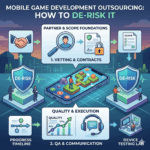
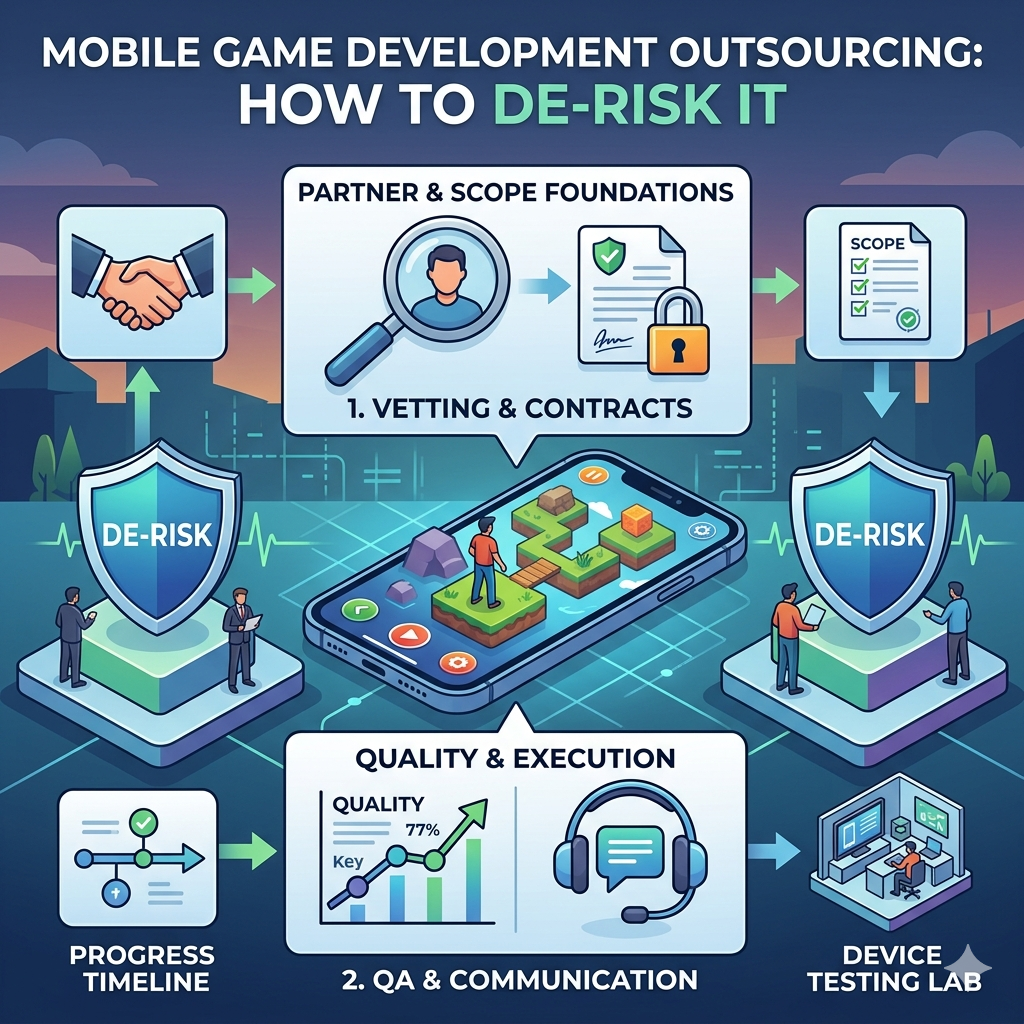
Step 1: Vet the Game Development Studio Properly
Portfolio decks are marketing. You need primary sources.
- Check the Play Store and App Store developer pages directly. Look at install counts, ratings, and release dates. A studio that claims 40 shipped games but has three live apps with 100 installs each is misrepresenting itself.
- Ask for real code samples and GDDs from past projects. Mature studios have real artifacts. Vague answers here are a red flag.
- Verify the team is in-house. Ask for LinkedIn profiles of the actual engineers, artists, and designers who’ll work on your project. Confirm they’re full-time employees – not freelancers booked for your sprint.
- Confirm compliance where it matters. Kids’ games? COPPA. EU users? GDPR. Enterprise clients? ISO 27001. Get evidence, not promises.
- Get three real client references – not testimonials, phone numbers. Studios that hide their past clients usually have reasons.
Step 2: Lock the Scope With a Game Design Document
The GDD is your contract anchor. Without one, every dispute becomes he-said-she-said.
Your GDD should specify:
- Core mechanics and game loop – what does the player actually do every 30 seconds?
- Level count, structure, and difficulty curve.
- Art style with reference images and a target asset list.
- Monetization model – IAP, ads, hybrid, premium – down to placement.
- Platform and device support: Android API level floor, iOS version floor, minimum specs.
- “Definition of done” per feature. When is the inventory system complete? Spell it out.
If your studio offers to co-author the GDD with you, that’s a green flag. If they don’t have a GDD template to start from, walk away.
Step 3: Use a Milestone-Based Payment Structure
Cash flow is your only real leverage. Don’t give it away.
- Never pay more than 20% upfront. A studio that demands 50% before work starts has cash flow problems – and those problems shouldn’t become yours.
- Tie payments to demoable milestones. Vertical slice, playable alpha, content lock, beta, soft launch. Each should be testable on your phone before money moves.
- Hold 10–15% retention until 30-60 days post-launch to cover stabilization fixes.
A reasonable split for a six-month project: 20% kickoff, 20% playable build, 20% content lock, 20% beta, 10% launch, 10% post-launch retention. Adjust to your risk appetite, but never let the studio get more than one milestone ahead of delivery.
Step 4: Bullet-Proof the Contract
This is where projects live or die. Don’t sign a generic template without these clauses.
IP ownership clause
- Full assignment of all source code, art assets, audio, design documents, and derivative works to you upon final payment.
- No retained license for the studio to reuse your code or assets in other projects (unless explicitly carved out – for example, generic internal tooling).
- Pre-existing studio IP must be listed and licensed separately.
Source code escrow
- For any project above roughly $30K / ₹25 lakhs, set up code escrow with a neutral third party. If the studio disappears, you still get the code.
NDA and mutual non-solicit
- Mutual NDA covering business plans, designs, and unreleased mechanics.
- Non-solicitation of each other’s employees for 12-24 months – protects both sides.
Termination and wind-down clause
- Define what happens if you stop work mid-project: handoff deliverables, source code transfer, final payment formula, license keys.
- A clean exit clause protects both sides and signals a mature studio. Studios that resist defining this are usually the ones you’d most want a clean exit from.
Step 5: Run a Tight Communication Cadence
Most failed projects had perfectly competent engineers. They just couldn’t talk to each other.
- Daily async stand-ups in Slack or Teams. Three lines per person: yesterday, today, blockers.
- Weekly demoable build, even if rough. If you can’t tap a button and see progress every week, something is wrong.
- Shared work board – Jira, Linear, Trello, ClickUp. Pick one. Email-only project management is how projects die in 2026.
- 2-3 hours of time-zone overlap per day, minimum. Schedule daily syncs inside that window.
One non-negotiable: a named, dedicated project manager on the studio side. Not a rotating account exec – one human who owns delivery end-to-end.
Step 6: Don’t Skip QA in the Outsourcing Scope
QA is the first thing cut to win a cheap bid. Don’t let it happen on your project.
Insist on three layers in the contract:
- Functional testing – does every feature work as specified in the GDD?
- Compatibility testing on a defined device matrix. Include low-end Android (₹8,000-12,000 phones) because that’s where 60%+ of emerging-market installs come from.
- Performance testing – frame-rate floors, memory ceilings, battery draw benchmarks.
Also test:
- Fresh installs vs. upgrades from previous versions
- Account migration and cloud save edge cases
- Network interruption and recovery
- Long-session stability (2+ hour sessions)
Get the device coverage matrix in writing before signing the contract – not as an afterthought during beta.
Outsourcing Red Flags to Walk Away From
If you see any of these during discovery, end the conversation:
- Refusal to sign an NDA before discussing your concept. Standard NDAs are signed in minutes. Hesitation here means they don’t respect confidentiality.
- Quotes 50%+ below market. Either they’re losing money on the project (and will cut corners), or they’re not really doing the work.
- No clear project manager assigned. “We’ll figure that out later” means nobody owns delivery.
- Vague IP transfer language. “All IP transferred upon completion” without specifying source code, assets, and design documents is a trap.
- No portfolio of shipped Unity (or Unreal) games. Pitch decks ≠ shipped products. If you can’t open the App Store and play their work, something is off.
FAQs: Mobile Game Development Outsourcing
Is outsourcing mobile game development to India safe?
Yes, provided you vet properly. India has the deepest Unity talent pool outside the US, mature legal frameworks for IP transfer, and strong English-language project management. The risk isn’t the country – it’s choosing a studio without due diligence. The same vetting rules apply whether you outsource to Bangalore, Ho Chi Minh City, Kyiv, or Warsaw.
What’s the average failure rate of outsourced game projects?
Industry estimates put outright failure (cancelled, scrapped, or shipped non-functional) at 30-40% for outsourced game projects. Projects that follow structured vetting, milestone-based payments, and proper contracts drop that rate dramatically – often below 10%.
Who owns the source code after the project ends?
Whoever the contract says owns it. If your contract doesn’t include an explicit IP assignment clause naming you as the owner of all source code, art, and design documents upon final payment, you may not own it – even if you paid for it. Get this in writing before kickoff, not at handover.
How do I switch studios mid-project?
First, invoke your termination clause and request a full handoff package: latest source code, asset libraries, design documents, build configurations, and any third-party license keys. Then have the new studio audit the codebase before quoting continuation work. Expect a 2-4 week ramp-up regardless of code quality – context loss is real and unavoidable.
The De-Risked Outsourcing Mindset
The studios that fail outsourced projects aren’t always bad operators – but the structures they work under almost always are. Loose scope, vague contracts, QA tacked on at the end, no source-code escrow. Founders who get burned the first time usually didn’t get burned by people. They got burned by missing process.
The good news: every failure mode in this post is preventable with paperwork you can put in place before the first line of code is written. Use the checklist, lock the GDD, structure the payments, demand the contract clauses, and instrument the communication. Do that, and outsourced mobile game development becomes one of the highest-leverage moves a founder, publisher, or agency can make.
Ready to scope your next mobile game project with a studio that puts these structures in place from day one?