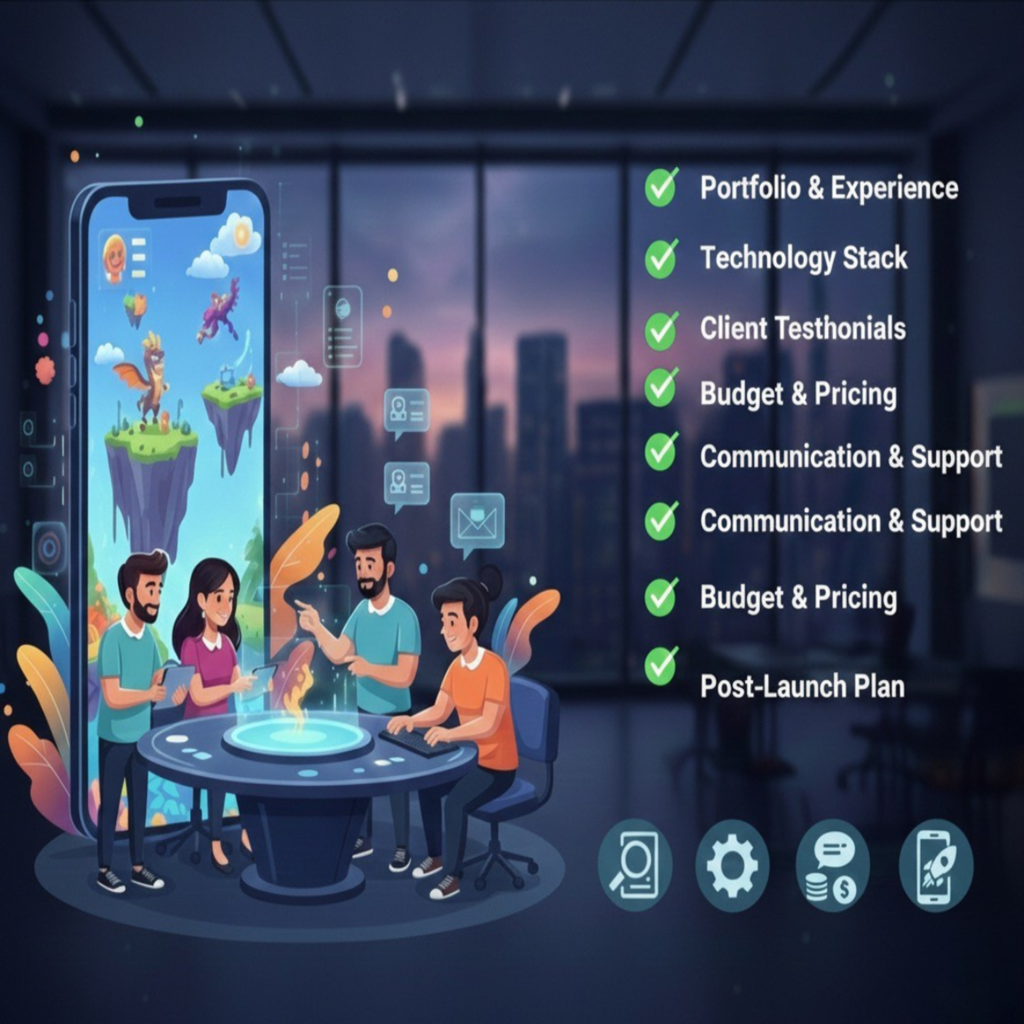
If you’re searching for a mobile game development company in India, you’ll find hundreds of studios claiming they can build “any game.” But choosing the right game development partner is less about fancy screenshots and more about: shipping quality builds, hitting milestones, optimizing performance on real devices, and supporting your game after launch (updates, bug fixes, LiveOps).
This guide is written for founders, publishers, and businesses who want to hire a game development company in India (or hire Unity developers in India) and avoid common outsourcing mistakes like missed timelines, unstable code, poor QA, or unclear IP ownership. Many partner-evaluation guides also emphasize portfolio proof, reviews, and technical capability as key decision factors.
Why India is a popular choice for mobile game development
India has become a major hub for mobile game development outsourcing because you can access skilled teams (Unity/Unreal, 2D/3D art, UI/UX, backend) at competitive cost, often with flexible engagement models (fixed cost, dedicated team, milestone-based). That said, “more options” also means more risk if you choose based only on price or visuals.
Step 1: Get clear on what you’re building (before you shortlist anyone)
Before you contact any mobile game development studio, write down:
Project clarity checklist
- Game type: hyper-casual / casual / puzzle / hybrid-casual / mid-core
- Platform: Android / iOS / both / WebGL
- Engine preference: Unity or Unreal Engine
- Core loop: what the player does repeatedly (30 seconds)
- Must-have features: levels, shop, IAP, ads, live events, leaderboard, multiplayer
- Art style: 2D / 3D / stylized / realistic
- Target devices: low-end Android? mid-range? iPhone versions?
- Budget & timeline: realistic milestone plan
The clearer your scope is, the easier it is to compare studios fairly and avoid scope creep later (a common outsourcing failure point).
Step 2: The ultimate partner selection checklist (India-focused)
1) Portfolio that proves real shipping (not just mockups)
A good mobile game development company in India should show:
- Live links (Google Play / App Store) or playable builds
- Game genres similar to yours
- Evidence they can handle real-world constraints: performance, device fragmentation, store compliance
- Case studies showing how they solved problems (not just “we built X”)
Questions to ask
- “Which games did you take from prototype → soft launch → global release?”
- “Can you share 2–3 case studies with challenges + solutions?”
- “Who owned the IP and publishing rights in those projects?”
(Strong hiring guides consistently recommend verifying case studies, reviews, and proven delivery rather than just visuals.)
2) Technical capability: Unity/Unreal + mobile optimization
If you’re hiring a Unity game development company in India, confirm they can handle:
- Performance optimization (FPS stability, draw calls, memory, loading)
- Addressables/asset bundles, object pooling, profiling
- Android build pipeline (Gradle, SDK/NDK), iOS builds (Xcode, CocoaPods)
- Clean architecture (maintainable code for updates)
Questions to ask
- “What’s your approach to optimizing for low-end Android phones?”
- “How do you profile CPU/GPU bottlenecks in Unity?”
- “How do you structure code so new features don’t break old systems?”
3) Quality Assurance (QA) and testing process
Many projects fail because teams “test at the end.” A serious mobile game development agency should have:
- Device testing plan (real devices, not only emulators)
- Smoke tests per build
- Regression testing before releases
- Clear bug-tracking workflow (Jira/Trello + severity labels)
Questions to ask
- “How many QA testers will be assigned?”
- “What devices do you test on (Android + iOS)?”
- “How do you manage crash reporting and hotfixes?”
4) Game design support (not only development)
If you want a partner who improves your retention and monetization, look for:
- Core loop + meta loop understanding
- Level design system (how they will create scalable levels)
- Economy tuning (progression pacing, rewards)
- Onboarding + tutorial flow
Questions to ask
- “Who designs the first 10 minutes of gameplay?”
- “How will you increase Day-1 retention?”
- “Do you provide a GDD and balancing sheet?”
5) Monetization & analytics integration experience
For most mobile games, success requires:
- Ads integration (rewarded, interstitial, banner) + mediation
- IAP integration
- Analytics events and funnels
- Remote config / A/B testing (if needed)
Questions to ask
- “Which ad mediation SDKs have you integrated?”
- “How do you place rewarded ads without harming retention?”
- “Can you define a clean event plan (tutorial funnel, level funnel, purchase funnel)?”
6) Art, UI/UX, and production pipeline
A “pretty” game is not enough. You need consistent pipeline:
- 2D/3D style guide (colors, materials, lighting references)
- UI/UX system (reusable components, scaling for screen sizes)
- Asset naming/version control and iteration workflow
Questions to ask
- “Do you create a style guide and UI kit in the beginning?”
- “How do you manage revisions for characters/UI?”
- “What’s your 3D optimization approach (polycount, textures, atlas, LOD)?”
7) Communication, reporting, and project management
Your partner should run predictable delivery:
- Weekly sprint plan + backlog
- Regular demo builds
- Transparent risk reporting (what’s behind schedule and why)
Questions to ask
- “How often do we get builds (weekly / bi-weekly)?”
- “Who is the single point of contact (PM/Producer)?”
- “What happens if a milestone slips?”
(Partner-selection frameworks frequently highlight communication structure and delivery reliability as core evaluation criteria.)
8) IP ownership, source code access, and contract clarity (VERY IMPORTANT)
When hiring a game outsourcing company in India, contracts must clearly define:
- IP ownership (game, code, assets)
- Source code delivery (Git repo access)
- Payment milestones + acceptance criteria
- NDA, confidentiality, and usage rights
- Support terms after launch (bug fixing window)
Non-negotiables
- You should know exactly who owns: game name, characters, codebase, assets, store accounts
- You should have a process for handing over: repo + builds + documentation
9) Post-launch support & LiveOps readiness
Many studios disappear after delivery. A good partner offers:
- Post-launch maintenance plan
- OS/device updates support
- Content updates (new levels, events)
- Crash + ANR monitoring and fix cycles
Questions to ask
- “What’s included in 30/60/90 days post-launch support?”
- “Do you support ongoing content updates and LiveOps?”
- “How fast can you deliver a hotfix if the game crashes after release?”
Step 3: Red flags to avoid (quick screening)
❌ They refuse to share playable builds or real store links
❌ Everything is “yes” without asking about scope or constraints
❌ No QA plan, no testing devices, no bug-tracking system
❌ Unclear IP and source-code terms
❌ Unrealistic timelines (e.g., “full game in 2 weeks”)
❌ No documentation, no version control, no milestone acceptance process
Step 4: A copy-paste “Vendor Evaluation Scorecard” (simple)
Use this scoring (1–5) to compare 3–5 shortlisted companies:
- Portfolio relevance (similar genre + shipped games)
- Unity/Unreal technical depth
- Mobile optimization capability
- QA process & device coverage
- Design + monetization understanding
- Communication & project management
- IP/contract clarity + source access
- Post-launch support plan
- Team composition (dev + art + QA + PM)
- Value-for-money (not just cheapest)
Pick the team with the highest total score — not the lowest price.